
Attending Pack EXPO 2026 CHICAGO? See our delta robot in action! Visit us at North Hall N-5584
Adeeb Robotics

Food & Beverage

High-speed automation built for hygienic production

Delta robot automation for food and beverage production — IP65-rated, FDA-compliant, 200+ PPM throughput.

Industry Challenge

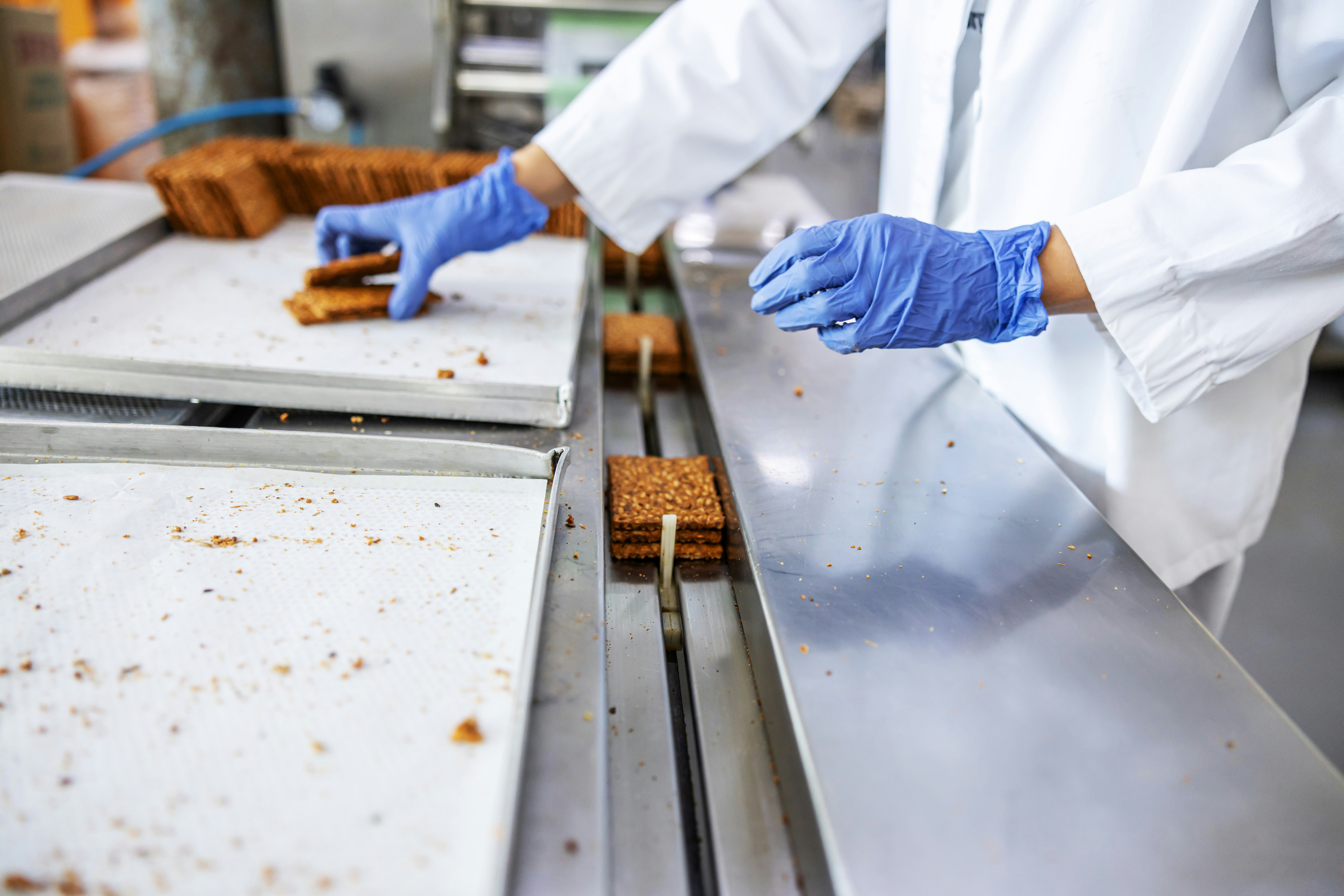
Food and beverage lines run 16–24 hours a day under strict hygiene mandates. Manual handling introduces contamination risk and cannot sustain the 200+ PPM throughput modern packaging lines demand. Equipment must withstand daily cleaning protocols without degradation, and frequent SKU changes — seasonal products, promotional packs, retailer-specific formats — require rapid changeover without mechanical retooling.

Product fragility adds another dimension: bakery goods, confectionery, and fresh produce bruise or break under conventional automation. The handling system must combine speed with gentleness, and the entire cell must meet FDA and EU food-contact standards from end-effector to enclosure.

Manual vs. Automated: Industry Benchmarks

MetricManual BaselineWith Robotic Automation
Throughput14–20 picks/min per worker, declining to ~14 by end of shift120–200 picks/min per delta robot
Labor4–8 workers per station per shift1 operator overseeing multiple cells; 35–42% direct labor hour reduction
Product wasteHigher from handling damageNear-zero misplacement at <0.1mm repeatability
Typical payback10–18 months

Sources: PMMI, AMD Machines, Food Engineering Magazine.

Product-Solution Fit

Application Problem Products Solution Key Metric
Pick & Place Sortation Manual sorting hits fatigue ceiling at ~80 PPM Vision-guided conveyor tracking with parallel kinematics 200+ PPM; 175% throughput increase
Tray Loading Inconsistent product placement causes downstream jams Multi-pattern recipe-driven placement 30-second SKU changeover
Carton Packing Labor-intensive packing with high turnover Turnkey multi-robot cell 75% labor reduction
Bakery & Confectionery Handling Fragile products crushed by rigid automation S-curve acceleration profiles with configurable jerk limits Product waste: 3.2% → 0.4%
Washdown Packaging Standard robots degrade under daily cleaning protocols Stainless steel construction, sealed joints, food-grade materials Daily high-pressure wash; zero degradation
Quality Inspection & Grading Visual defects escape manual inspection at speed EtherCAT-triggered vision with AI classification 99.9%+ detection; <5 ms latency

Standards

FDA 21 CFR 110/111 — cGMP for Food Processing

Current good manufacturing practice regulations governing food processing and dietary supplement manufacturing, covering personnel, facilities, equipment, and process controls.

Allows your production line to pass FDA facility inspections without additional equipment modifications or manual process workarounds.

FDA 21 CFR 177 — Food Contact Materials

FDA regulation specifying approved polymers and materials for surfaces that come into direct contact with food during processing and packaging.

Eliminates the need for secondary containment or barrier materials between the robot end-effector and your product, simplifying cell design.

NSF/ANSI 169 — Sanitary Equipment Design

Standard for the design, construction, and materials of food handling and processing equipment to ensure cleanability and prevent contamination.

Qualifies the automation cell for direct food-zone operation, avoiding the cost of secondary enclosures or manual handling fallback.

ISO 22000 — Food Safety Management

International standard for food safety management systems covering hazard analysis, critical control points, and prerequisite programs across the food chain.

Supports your facility's HACCP plan by providing equipment with documented hygiene ratings and cleanability, reducing audit findings.

EU 852/2004 — Food Hygiene Regulation

European regulation establishing general hygiene requirements for food business operators at all stages of production, processing, and distribution.

Enables deployment in EU food facilities without requiring additional hygiene risk assessments for the automated handling equipment.

EU 178/2002 — Traceability

European food law requiring traceability of food, feed, and ingredients at all stages of production, processing, and distribution.

Built-in batch logging and event recording support your facility's one-up/one-down traceability obligations without custom integration work.

FSMA — Preventive Controls for Food Safety

FDA Food Safety Modernization Act requiring food facilities to implement preventive controls, hazard analysis, and supply chain verification.

Automated process data collection and hazard monitoring satisfy FSMA documentation requirements, reducing manual recordkeeping burden.

Ready to automate your food & beverage production?

Our industry specialists will design a configuration matched to your throughput, compliance, and integration requirements.