
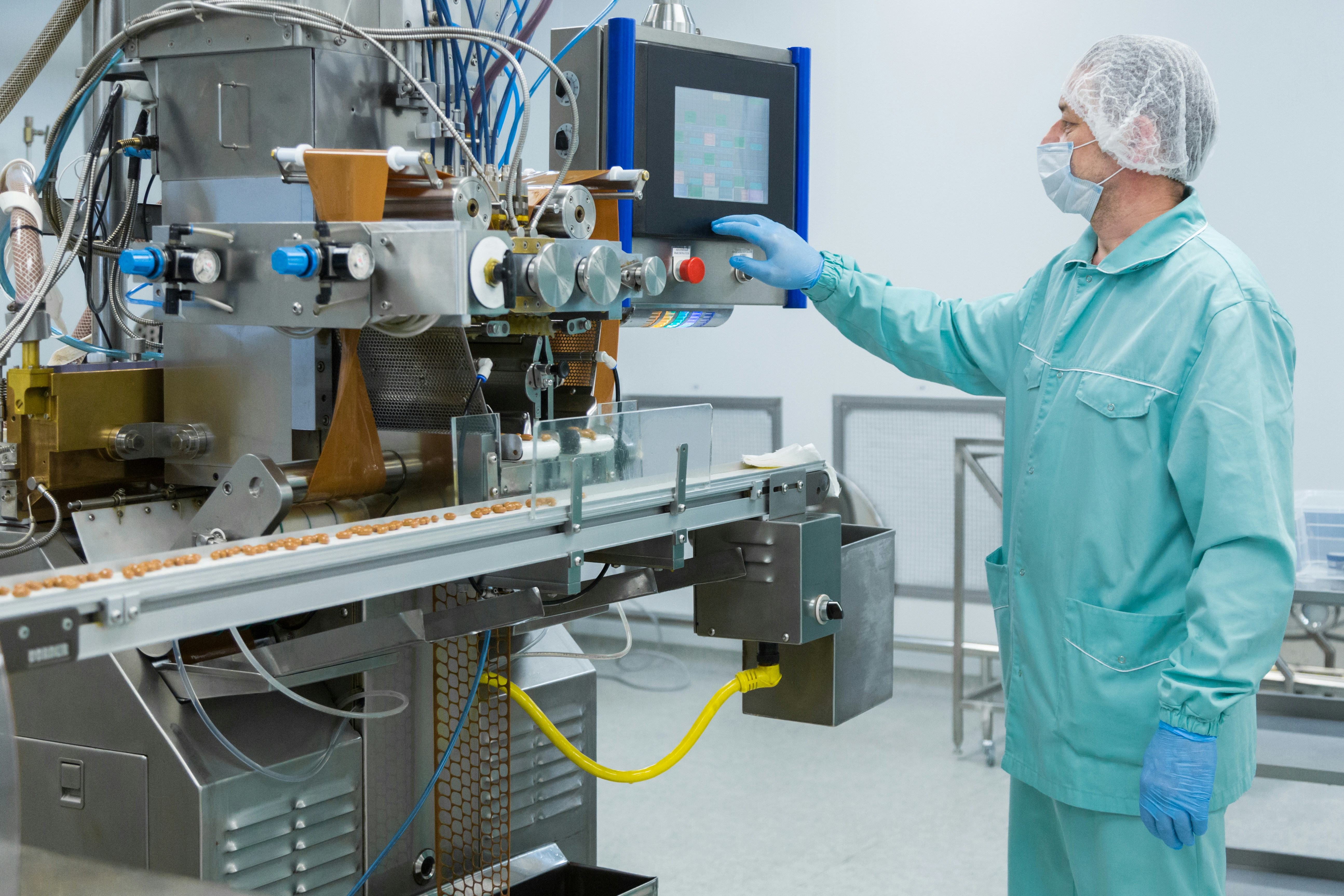
Industry Challenge
Medical device manufacturing combines the precision demands of electronics with the compliance rigor of pharmaceuticals. Single-use devices — lancets, test strips, syringes, inhalers — require high-volume assembly at 200+ PPM with zero-defect tolerance. A single defective unit can trigger a recall affecting millions of devices.
Force-controlled insertion is critical for needle-to-barrel mating and snap-fit housings. Every unit needs a complete audit trail from raw material to finished device, with electronic records that satisfy FDA Part 11 requirements.
Manual vs. Automated: Industry Benchmarks
| Metric | Manual Baseline | With Robotic Automation |
|---|---|---|
| Throughput | Low-volume manual assembly | 100+ units/min on high-speed automated lines |
| Precision | Human variability in placement | ±0.01mm repeatability |
| Defect rate | Variable; major regulatory risk | Near-zero with 360-degree vision inspection |
| Market trajectory | — | Syringe assembly automation market: $14.5B (2024) → $26.75B projected by 2032 |
Specific manual vs. automated throughput comparisons for medical device assembly are limited in public sources. Sources: ESSERT Robotics, industry market reports.
ISO 13485 Compliance Architecture
ISO 13485 governs medical device manufacturers, not their equipment suppliers directly. Adeeb is not required to hold ISO 13485 certification — but medical device manufacturers must qualify production equipment under their own QMS. Adeeb’s products are designed to make that qualification straightforward.
What Adeeb Products Provide
| ISO 13485 Requirement | Adeeb Capability |
|---|---|
| Document Control (4.2.5) | Robot Controller produces electronic batch records with timestamped logs. Python API enables structured export to MES and ERP systems. |
| Design Controls (7.1) | Adeeb provides design verification reports and IQ/OQ/PQ protocol templates for all products to support customer validation activities. |
| Risk Management (7.3.7 / ISO 14971) | Delta Robot’s force control with configurable limits and emergency stop integration reduces process risk. IP65 sealed stainless steel construction minimizes contamination risk. |
| Production Controls (7.5.1) | ±0.05mm repeatability and deterministic EtherCAT communication ensure consistent, reproducible processes across production runs. |
| Process Validation (7.5.2) | Adeeb supplies factory acceptance test data, calibration certificates, and validation documentation packages for on-site OQ/PQ. |
| Traceability (7.5.3) | Controller logs per-unit production data via Python API. EtherCAT Master provides deterministic timestamps for every motion event, feeding directly into Device History Record systems. |
| Infrastructure (6.3) | IP65 sealed construction with stainless steel and non-particle-shedding materials for cleanroom compatibility. |
| Monitoring & Measurement (7.6) | Factory-calibrated hardware with traceable calibration certificates. Force sensing with documented calibration records. |
Shared Responsibility
Adeeb’s role is compliance enabler, not compliance holder. The medical device manufacturer is responsible for site-specific IQ/OQ/PQ execution, supplier qualification audits, process FMEA authorship, Device History Record integration, recalibration scheduling, and maintaining the ISO 13485 certification. Adeeb provides the deterministic hardware, audit-ready data streams, and validation documentation that make the manufacturer’s compliance obligation achievable without custom engineering.